Materials & Chemistry
Chemical Engineering
Discover chemical reactor dynamics, reaction rate laws, and conservation equations with workflows suited to reactor and separation train data.
One of 34 industries across 8 sectors served by ARDA — the research discovery engine.
The Challenge
Why Chemical Engineering needs a new approach to discovery
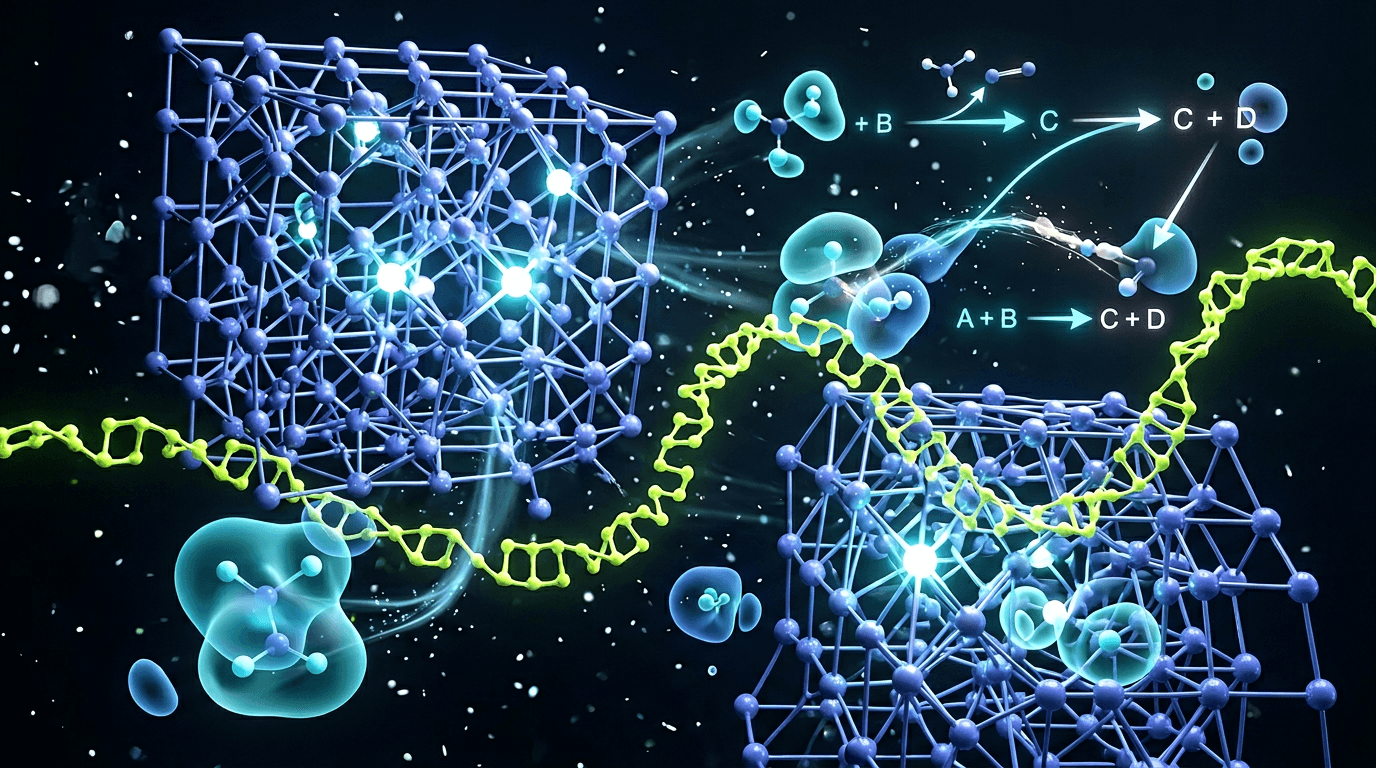
Chemical engineering processes — reactors, distillation columns, heat exchangers, separation trains — generate continuous streams of process data: temperature profiles, pressure readings, flow rates, composition measurements, and conversion metrics. The governing relationships in these systems are rooted in conservation laws, reaction kinetics, and transport phenomena, but extracting accurate rate laws and transport correlations from real plant data remains a persistent challenge. Process conditions drift, instruments degrade, and side reactions introduce unmodeled dynamics. Engineers typically rely on textbook kinetic forms or small-scale laboratory fits that do not translate reliably to industrial operating conditions.
Traditional reaction engineering assumes known stoichiometry and pre-specified rate law forms — Arrhenius kinetics, power-law models, Langmuir-Hinshelwood mechanisms — then fits parameters from controlled laboratory experiments. These models frequently fail under industrial conditions where heat and mass transfer limitations, catalyst deactivation, and impurity effects alter the effective kinetics. Separation processes face analogous challenges: thermodynamic models calibrated on pure-component data often deviate when applied to complex industrial mixtures. The result is a persistent gap between laboratory-derived models and plant-floor reality, leading to suboptimal process design, over-conservative safety margins, and missed efficiency opportunities.
The ARDA Approach
How ARDA transforms chemical engineering
ARDA ingests raw process data — reactor temperature and concentration time-series, distillation tray compositions, heat exchanger duty measurements — and produces typed scientific claims about the governing kinetics, transport correlations, and conservation relationships. It discovers rate laws and transport equations directly from operating data without requiring pre-specified functional forms. ARDA's conservation law detection is particularly valuable for chemical systems, automatically validating material and energy balances and identifying violations that indicate measurement errors, instrument drift, or unknown side reactions that laboratory models did not anticipate.
ARDA's Symbolic mode excels at extracting closed-form rate laws and heat transfer correlations from process data, producing equations that process engineers can directly interpret, validate, and implement in plant control systems. The Evidence Ledger records every discovery with full provenance — data lineage, configuration, and replay recipe — meeting the documentation requirements of process safety management and regulatory compliance. Negative controls including bootstrap stability testing and feature shuffle ensure that discovered kinetics reflect genuine physical relationships rather than artifacts of noisy industrial data or confounded operating variables.

Discovery Engine
The engine behind the discovery
The Symbolic and Causal modes are most critical for chemical engineering. Symbolic discovery identifies closed-form rate laws, mass transfer correlations, and thermodynamic relationships that integrate directly into process simulators and control systems. Causal mode maps causal relationships between operating parameters — temperature, pressure, catalyst age, feed composition — and process outcomes like conversion, selectivity, and product purity, enabling root-cause analysis when processes deviate from specification. The Neuro-Symbolic mode handles complex reaction networks where symbolic forms alone may not capture the full dynamics, providing neural encoding with subsequent distillation into interpretable governing equations.
Symbolic
Discovers closed-form governing equations — the explicit mathematical laws that describe how systems behave. Produces human-readable, interpretable formulas.

Neural
Deploys physics-informed architectures for high-dimensional, symmetry-rich data where closed-form solutions may not exist.

Neuro-Symbolic
Combines neural encoding with symbolic distillation — learns complex representations first, then extracts interpretable governing laws from those representations.

CDE
The Causal mode, powered by ARDA's Causal Dynamics Engine (CDE), discovers true cause-and-effect relationships from observational data — identifiable causal graphs, regime classifications, and intervention predictions.
Typed Scientific Claims
What ARDA discovers
Every discovery ARDA produces is a typed scientific claim — not a black-box prediction, but a governed, reproducible, auditable piece of scientific knowledge with full provenance.
- Reaction rate governing equations
- Heat transfer correlations
- Mass transport laws
- Conservation law validation
- Catalyst deactivation dynamics



Governed Discovery
Built for regulated industries
Every discovery ARDA produces carries governance metadata: a truth dial setting that controls the confidence threshold, an evidence ledger entry with deterministic replay recipe, and negative control results including bootstrap stability, out-of-distribution testing, and feature shuffle validation.
For chemical engineering, this means every scientific claim is auditable, reproducible, and suitable for regulatory submission, peer review, or board-level decision-making. The governance stack is not optional — it is embedded in every discovery run.
Same sector
Related industries
Materials Science
Analyze molecular dynamics trajectories with physics-informed architectures to discover material property laws and phase transitions.
ViewPolymer Science
Identify governing equations of polymer dynamics — viscoelastic laws, crystallization kinetics, and degradation mechanisms.
ViewNanotechnology
Discover governing physics at the nanoscale — quantum confinement, surface energy laws, and self-assembly dynamics.
ViewGet started
Start discovering with ARDA
Whether you are exploring chemical engineering data for the first time or scaling an existing research programme, ARDA adapts to your workflow. Create an account, connect your data, and let the engine surface the governing laws hidden in your experiments.