Advanced Technology
Quantum Computing Research
Discover decoherence dynamics, gate error laws, and qubit interaction equations from quantum hardware characterization data.
One of 34 industries across 8 sectors served by CDE — the Causal Dynamics Engine for Science and Engineering.
The Challenge
Why Quantum Computing Research teams still struggle to explain what is happening
Quantum computing hardware characterization produces data with unique physical structure: qubit coherence decay curves, gate fidelity measurements, cross-talk matrices, and error syndrome distributions. These datasets grow rapidly as processor scale increases, with error mechanisms that compound across qubit arrays in ways conventional statistical methods cannot characterize. Research teams face the fundamental challenge of extracting coherent physical models from noisy quantum measurements where decoherence, leakage, and cross-talk create interacting error sources that are difficult to disentangle.
Standard characterization protocols provide aggregate performance metrics but struggle to identify the physical mechanisms driving errors. These methods typically assume specific noise models and cannot discover unknown error dynamics or interaction pathways. As processors scale beyond small qubit counts, the combinatorial growth of potential error correlations makes exhaustive characterization impractical, forcing teams to iterate through hypothesized noise models manually.
The CDE Approach
How CDE closes the explanation gap in quantum computing research
CDE treats quantum hardware data as a discovery problem rather than a fitting problem. It ingests raw characterization data (coherence measurements, standard benchmark-style sequences, cross-talk sweeps) and discovers the governing equations of error dynamics without pre-specified noise models. Each discovered relationship is a typed scientific claim with confidence bounds and falsification test results, providing hardware teams with validated physical models of their specific processor's error dynamics.
Physics-informed architectures model the unitary and dissipative dynamics of quantum systems simultaneously, capturing the interplay between coherent evolution and decoherence. Symbolic mode extracts closed-form decoherence equations and error scaling models for validation against theoretical predictions and performance projection at larger qubit counts. The Evidence Ledger provides deterministic replay for every discovered error model, enabling teams to track how error dynamics evolve across hardware revisions and calibration cycles.
Discovery Engine
How CDE applies here
Causal mode maps how errors in one qubit affect neighbors through cross-talk, spectator effects, and correlated noise channels, enabling hardware teams to prioritize which error sources to address first. Neuro-Symbolic mode complements this by discovering the governing equations of decoherence dynamics, combining the engine's internal methods on complex quantum measurement data with structure extraction to produce interpretable physical models of processor behavior.
Causal Graphs
Discovers directed causal structure from observational data — identifiable causal graphs, regime classifications, and intervention predictions.
Governing Equations
Extracts compact governing laws grounded in the causal structure — interpretable equations your team can read, verify, and compare against known theory.
Intervention Design
Proposes targeted experiments to resolve ambiguous causal edges — maximizing information gain where the causal structure is still uncertain.

Causal Validation
Negative controls, falsification tests, and identifiability analysis applied to every causal claim before promotion to the evidence ledger.
Typed Scientific Claims
What CDE discovers
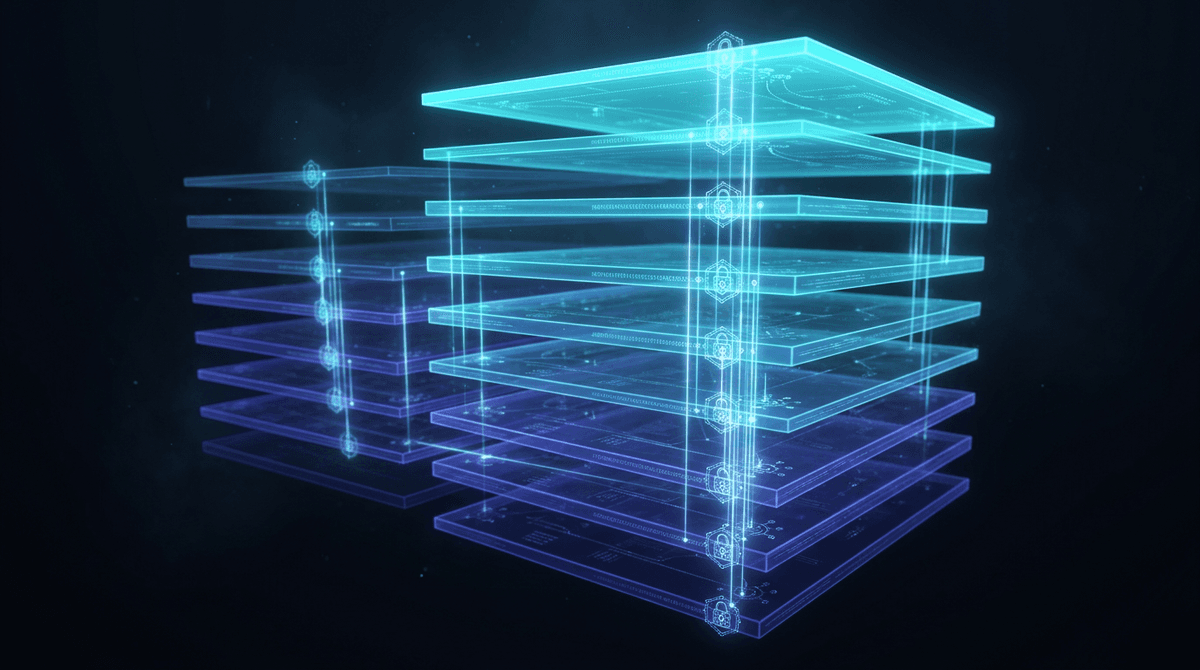
Every discovery CDE produces is a typed scientific claim — not a black-box prediction, but a governed, reproducible, auditable piece of scientific knowledge with full provenance.
- Decoherence dynamics equations
- Gate error scaling laws
- Cross-talk interaction models
- Error propagation causal graphs
- Qubit coupling dynamics

Governed Discovery
Make the finding reviewable
Every discovery CDE produces carries the review context around it: a Truth Dial setting, an evidence entry with replay context, and control results including bootstrap stability, out-of-distribution testing, and feature-shuffle validation.
For quantum computing research, that means teams can compare runs, justify decisions, and decide whether a finding is ready for internal use, external review, or regulated submission.
Same sector
Related industries
Semiconductor & Electronics
Discover device behavior laws, thermal dissipation equations, and process-yield relationships from semiconductor characterization data.
ViewRobotics & Autonomous Systems
Identify kinematic laws, control equations, and environmental interaction models for robotic systems directly from sensor data.
ViewAI & Machine Learning Research
Discover loss landscape dynamics, scaling laws, and optimization trajectories from ML training experiment data.
ViewGet started
Put CDE on a real quantum computing research problem
Whether you are exploring quantum computing research data for the first time or scaling an existing research programme, CDE adapts to your workflow. Bring the dataset, the decision pressure, and the constraints. We will map the right discovery path.