Material and Energy
Catalysis and Chemical Processing
Generate catalyst compositions and active-site candidates optimized for activity, selectivity, durability, and operating constraints.
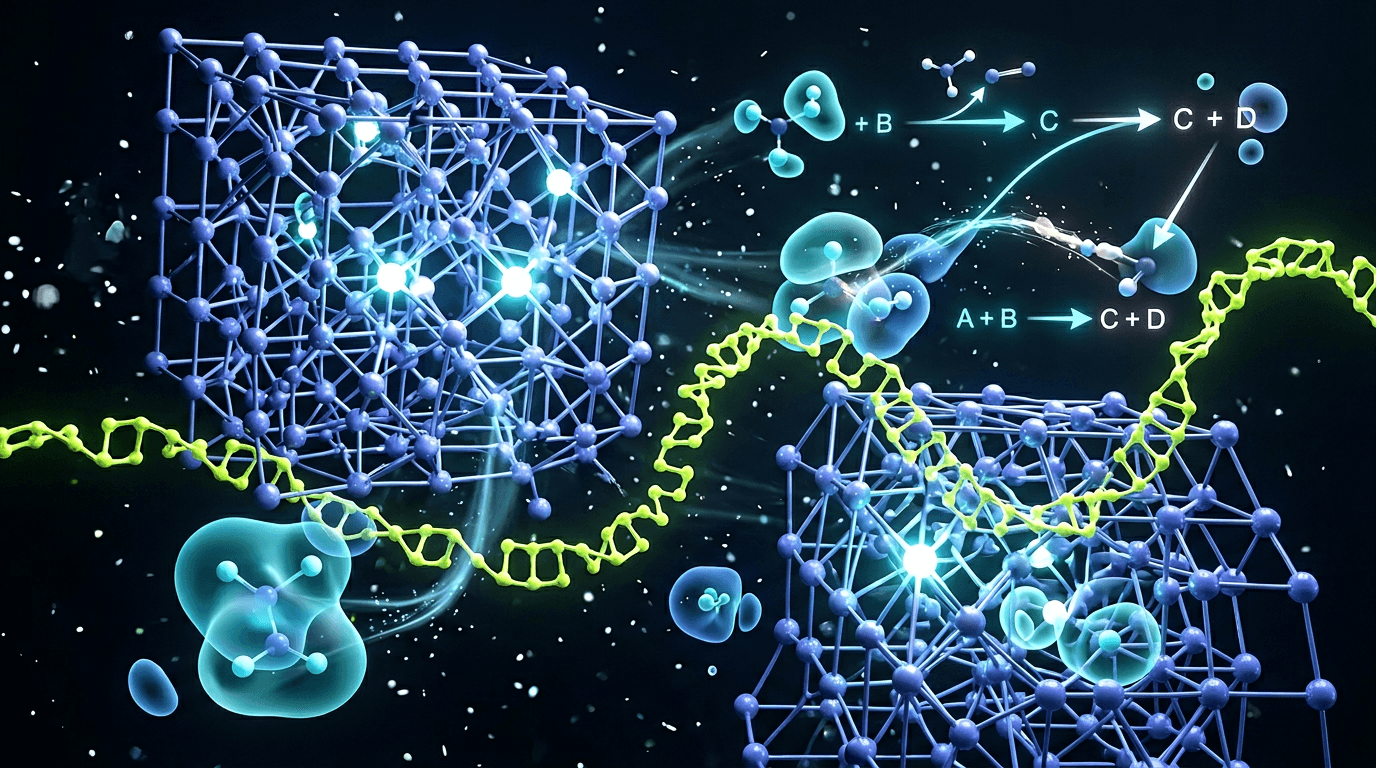
The Challenge
Why Catalysis and Chemical Processing teams still lose time to invalid candidate work
Catalyst discovery combines composition, structure, support effects, and operating conditions in one search problem. Small changes can improve one metric while destroying another.
Traditional workflows screen a narrow set of candidates from human intuition or database coverage. That misses underexplored regions and burns compute on weak or unstable options.
The MatterSpace Approach
How MatterSpace reduces invalid work in catalysis and chemical processing
MatterSpace generates catalyst candidates under declared constraints on composition, geometry, and practical operating windows so the search stays inside viable chemistry.
Teams get candidates they can push into simulation, surface analysis, or synthesis with a clearer view of selectivity, durability, and performance trade-offs.
Constraint-Based Generation
Specify what the output must satisfy. MatterSpace constructs candidates that meet all constraints simultaneously.
Valid by Construction
Every output satisfies physical laws, stability criteria, and domain constraints — no post-hoc filtering needed.
MatterSpace
Powered by MatterSpace, Vareon's material discovery product for candidate generation under real physical constraints.
Generation Output
What MatterSpace generates
- Catalyst compositions with predicted activity profiles
- Active-site structure candidates
- Support and surface configuration proposals
- Candidate sets balanced across selectivity and durability
Same sector
Related industries
Battery Cathodes and Energy Storage
Generate cathode compositions and crystal structures that balance energy density, cycle life, thermal stability, and manufacturability.
ViewSuperconductors and Quantum Material
Generate crystal candidates for superconducting and quantum-material programs with stability and target-property constraints built into the search.
ViewPhotovoltaics and Solar Energy
Generate absorber and material candidates for photovoltaic programs that must balance efficiency, stability, and manufacturing reality.
ViewThermoelectrics and Waste Heat Recovery
Generate thermoelectric material candidates that trade off transport behavior, stability, and practical deployment limits.
ViewHigh-Entropy Alloys
Generate multi-principal-element alloy candidates for teams balancing strength, durability, corrosion resistance, and processability.
ViewMagnets and Magnetic Material
Generate magnetic-material candidates for programs targeting strong performance without discovering structural or supply constraints too late.
ViewCoatings and Surface Engineering
Generate coating-material and surface-system candidates for teams balancing durability, adhesion, thermal behavior, and environment-specific constraints.
ViewSolid-State Electrolytes
Generate solid-electrolyte candidates that balance conductivity, stability, and compatibility with the rest of the cell architecture.
ViewMetamaterials
Generate metamaterial candidates for teams targeting coupled electromagnetic, acoustic, or mechanical behavior under real fabrication constraints.
ViewMetal-Organic Frameworks
Generate framework candidates for gas separation, storage, and catalytic programs that need porosity, selectivity, and structural stability together.
ViewPolymer Design
Generate polymer-material candidates that balance chemistry, architecture, processability, and the final property envelope.
ViewGet started
Put MatterSpace on a real catalysis and chemical processing problem
Whether you are exploring catalysis and chemical processing for the first time or scaling an existing research programme, MatterSpace generates novel candidates that satisfy your constraints by construction.
Contact us