Advanced Technology
AI & Machine Learning Research
Discover governing dynamics of training processes — loss landscapes, optimization trajectories, and scaling laws.
One of 34 industries across 8 sectors served by ARDA — the research discovery engine.

The Challenge
Why AI & Machine Learning Research needs a new approach to discovery
Machine learning research generates rich experimental data — training loss trajectories, gradient statistics, hyperparameter sweep results, scaling experiment logs, benchmark performance curves — that encode the governing dynamics of learning processes. Despite the field's rapid growth, the fundamental laws governing why certain architectures generalize, how training dynamics evolve, and what determines scaling behavior remain poorly understood. Research teams run thousands of experiments but extract governing relationships primarily through ad hoc analysis and visual inspection, lacking systematic methods for discovering the mathematical laws that govern optimization landscapes and learning dynamics.
Current approaches to understanding training dynamics rely on theoretical analysis under simplifying assumptions — infinite width limits, convex relaxations, independent gradient noise — that diverge substantially from practical deep learning settings. Empirical scaling law studies fit pre-specified functional forms to experimental data, but these assumed forms may not capture the true governing relationships. Phase transitions in training — sudden capability emergence, grokking phenomena, mode collapse events — are observed and catalogued but lack predictive governing equations. The absence of systematic discovery methods means that each new architecture family requires its own bespoke empirical analysis, with limited transfer of governing principles across settings.
The ARDA Approach
How ARDA transforms ai & machine learning research
ARDA treats machine learning experimental data as a scientific discovery problem, ingesting training logs, scaling experiment results, and benchmark trajectories to discover the governing equations of learning dynamics. Rather than fitting pre-specified scaling law forms, ARDA explores the space of possible mathematical relationships between compute, data, architecture parameters, and performance outcomes. This approach can surface governing relationships that researchers have not hypothesized — identifying previously unknown interactions between learning rate schedules and architectural choices that determine generalization behavior. Every discovered relationship is a typed scientific claim with confidence bounds and reproducibility guarantees.
ARDA's regime classification automatically identifies phase transitions in training dynamics — loss plateaus, sudden capability emergence, mode collapse boundaries — and characterizes the governing equations within each regime. This capability transforms how research teams understand training failures and architectural limitations. ARDA's symbolic discovery mode extracts closed-form scaling laws and training dynamics equations that researchers can use to make principled decisions about compute allocation and architecture design. The governance stack ensures every discovered scaling law includes deterministic replay, evidence provenance, and negative control validation, providing the reproducibility standards that machine learning research increasingly demands.

Discovery Engine
The engine behind the discovery
Symbolic discovery is particularly valuable for ML research, producing closed-form scaling laws and optimization dynamics equations that can be validated against new experiments and used for extrapolation. The Causal mode maps causal relationships between training configuration choices and performance outcomes — separating the effects of learning rate, batch size, architecture depth, and regularization on generalization rather than relying on confounded hyperparameter correlations. Neuro-Symbolic discovery handles the high-dimensional experimental spaces common in large-scale ML research, where neural encoders capture complex interactions across hundreds of experimental variables before symbolic distillation produces interpretable governing relationships.
Symbolic
Discovers closed-form governing equations — the explicit mathematical laws that describe how systems behave. Produces human-readable, interpretable formulas.

Neural
Deploys physics-informed architectures for high-dimensional, symmetry-rich data where closed-form solutions may not exist.
Neuro-Symbolic
Combines neural encoding with symbolic distillation — learns complex representations first, then extracts interpretable governing laws from those representations.
CDE
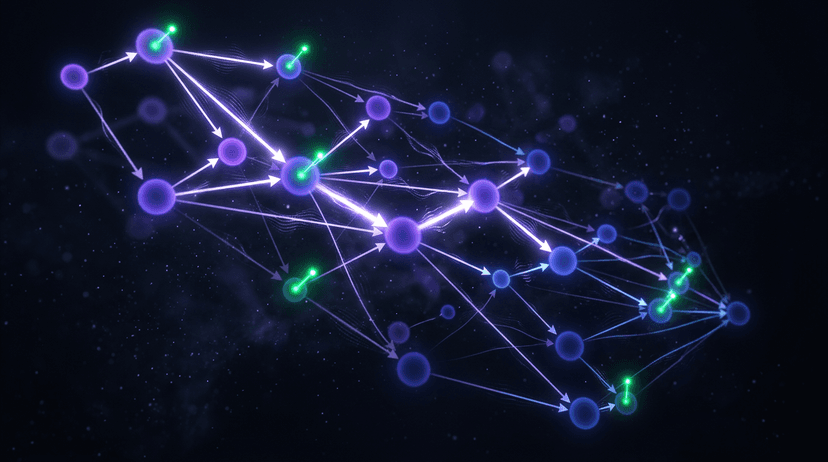
The Causal mode, powered by ARDA's Causal Dynamics Engine (CDE), discovers true cause-and-effect relationships from observational data — identifiable causal graphs, regime classifications, and intervention predictions.
Typed Scientific Claims
What ARDA discovers
Every discovery ARDA produces is a typed scientific claim — not a black-box prediction, but a governed, reproducible, auditable piece of scientific knowledge with full provenance.
- Neural scaling law equations
- Training dynamics governing models
- Optimization landscape topology
- Generalization bound discovery
- Architecture-performance relationships


Governed Discovery
Built for regulated industries
Every discovery ARDA produces carries governance metadata: a truth dial setting that controls the confidence threshold, an evidence ledger entry with deterministic replay recipe, and negative control results including bootstrap stability, out-of-distribution testing, and feature shuffle validation.
For ai & machine learning research, this means every scientific claim is auditable, reproducible, and suitable for regulatory submission, peer review, or board-level decision-making. The governance stack is not optional — it is embedded in every discovery run.
Same sector
Related industries
Semiconductor & Electronics
Discover physical laws governing semiconductor device behavior — switching dynamics, thermal dissipation, and process optimization equations.
ViewRobotics & Autonomous Systems
Identify governing dynamics of robotic systems — kinematic laws, control equations, and environmental interaction models.
ViewQuantum Computing Research
Discover decoherence dynamics, gate error laws, and qubit interaction equations from quantum hardware characterization data.
ViewGet started
Start discovering with ARDA
Whether you are exploring ai & machine learning research data for the first time or scaling an existing research programme, ARDA adapts to your workflow. Create an account, connect your data, and let the engine surface the governing laws hidden in your experiments.