Vareon's systems-first approach for reliable AI
Modern software works because it behaves. Same situation, same inputs, same result. And when it fails, it fails in ways engineers can reproduce, debug, and fix.
"The world does not reward cleverness; It rewards consequences."
The world is not a puzzle.
It is a living system.
Every serious domain already knows this. Reality is not solved once. It must be governed continuously.
Biology
A cell stays alive by constant correction.
Manufacturing
A factory stays in spec by monitoring and control.
Aerospace
A plane stays stable through feedback loops.
Business
A business survives by adapting under constraint.
Systems engineering has a hard rule:
"If failure is not bounded, it is not capability. It's a demo."
Capability is not generation. Capability is a contract.
It works under constraints.
It fails safely.
It can be tested.
It can be monitored.
It can be audited.
It can be certified.
That is the bar in:
Aerospace
Industrial control
Safety critical infrastructure
Regulated operations
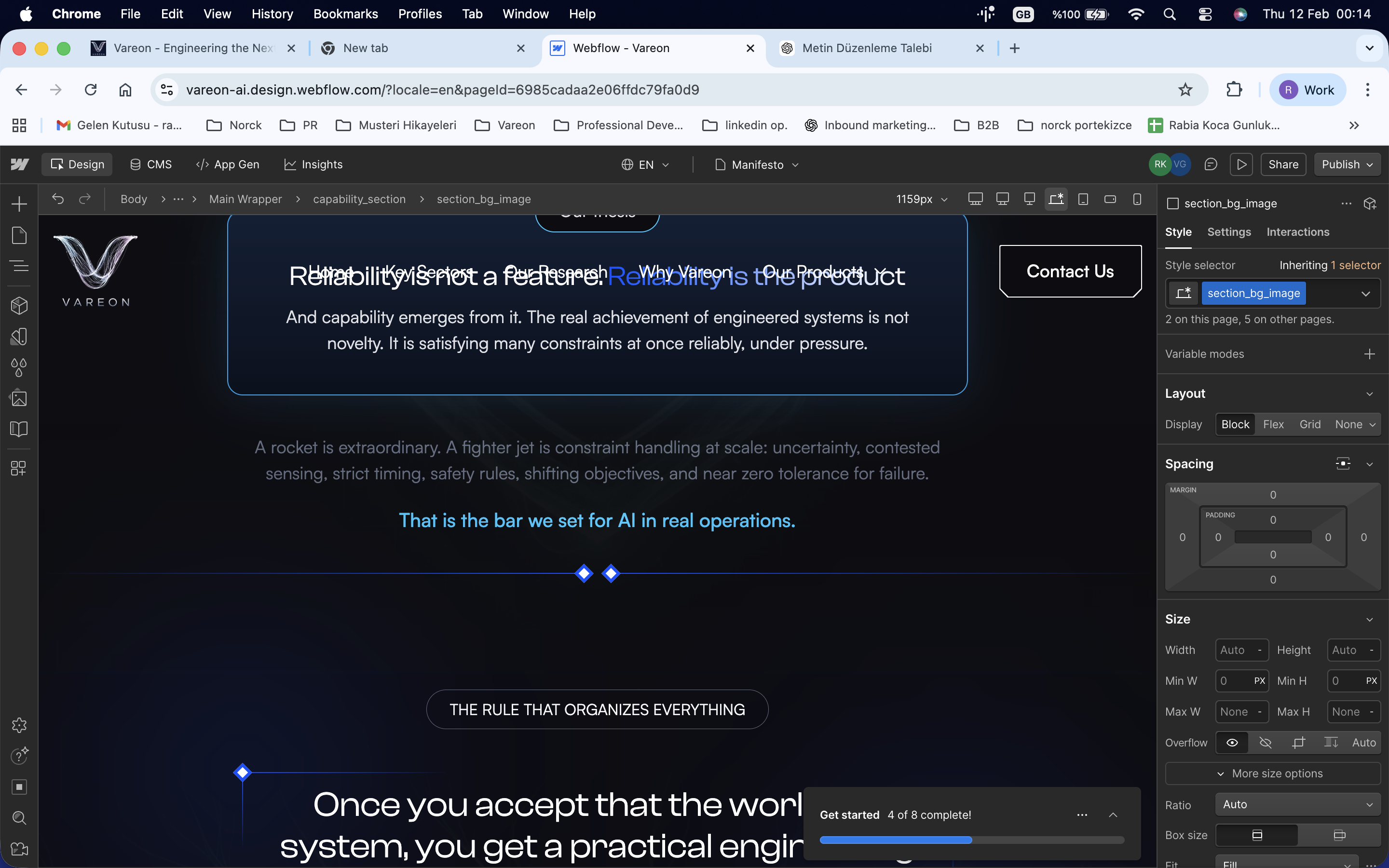
Reliability is not a feature. Reliability is the product
And capability emerges from it. The real achievement of engineered systems is not novelty. It is satisfying many constraints at once reliably, under pressure.
Our thesis
Once you accept that the world is a system, you get a practical engineering principle.
Model causally when you can. Correlate when you must.
Most AI correlates even when it should not, learning patterns without the scaffolding that makes behavior stable, inspectable, and governable.
We build that scaffolding.
This becomes three concrete capabilities
Prove Safety Before Action
Enforce Constraints During Generation
Keep Correctness After Shipping
Three pillars that work as one system.
Prove reliability before action
Acting safely is not predicting well. It is modeling what changes when you intervene.

Our stack is built around dynamic modeling for real world systems that evolve over time.
Capture what the system is, how it changes, and what limits must always hold.
Stress edge cases, timing limits, and failure modes early before consequences arrive.
This is how best effort becomes dependable behavior.
Model
Simulate
Enforce limits
Act
Monitor
Enforce constraints during generation
The transparent box force field generator
Generate first, filter later is a content strategy. In operations, it breaks under latency, noise, edge cases, and pressure, exactly when one bad sample is unacceptable.
So we change what generation means.
Instead of sampling and hoping, we run a controllable search through a solution space. Every step is shaped by intent and bounded by what must be true.
The process is a transparent box
Observable
steerable
reproducible
Hard constraints
non negotiable boundaries such as safety limits, compliance rules, and timing budgets.
Soft constraints
encode trade offs such as efficiency, cost, comfort, and performance margins.

This changes the promise you can make.
"Not we will generate many and filter the bad ones."
"We enforce constraints as we generate."
With the same inputs, constraints, and system configuration, outputs are reproducible and auditable the way engineers need.
Novelty becomes a controlled parameter
A knob that budgets exploration, not a surprise you apologize for.
That is what causation looks like in practice. A process you can reason about, test, and certify, not just results you can admire.
Keep correctness intact after shipping
Analytical Continual Intelligence and the viable contract
Real deployments do not fail only at launch. They fail over time. Sensors drift. Margins shrink. Conditions change. Requirements evolve.
A dependable AI system responds in disciplined ways
Tighten limits
Switch modes
Elevate uncertainty
Require additional checks
Fall back to safer controllers
Refuse actions outside the safe envelope
The goal is simple.
Keep the deployed system inside its viable contract as conditions change, without breaking the guarantees you already earned.

This is adaptation done like engineering
Budgeted
Compute, latency, and footprint are first class.
Gated
Protected behaviors cannot regress unnoticed.
Reversible
Rollback works like a production revert.
Auditable
What changed, why, and what it touched.
It also flips the economics
Fine tuning cycles are slow, expensive, disruptive, and risky.
Controlled micro updates replace the expensive thing big retraining with the cheap thing small targeted change, pushing heavywork off the critical path.
The win is not a single benchmark. It is a new operating model where improvement is cheap enough to do continuously, and controlled enough to keep reliability intact.
And we make it measurable with a scorecard that tracks how well the system stays within its contract over time.
We are not here to win demos. We are here to ship capability.
"We are not saying those approaches do not work. We are saying they optimize for a different contract than the one serious deployments require."
Reinforcement learning can be powerful and hard to certify in real operations. Rewards are sparse, delayed, gameable, and unsafe to explore. Diffusion is incredible at sampling, but sampling is not the same as producing valid solutions under operational constraints. Physics informed methods can be strong when equations and boundaries are clean, but many real deployments are not: mixed dynamics, partial rules, human sign offs, adversaries, compliance, timing budgets.
Diffusion is great at making things right.
We are built for what is right, even under stress.
Most AI treats the world as a prediction problem.
We treat it as a systems engineering problem.
And systems engineering has always had one rule.
"If you cannot bound failure, you do not have capability. You have a demo."
That is Vareon. We build AI as a system.
Dynamic modeling to prove safety before action.
Constraint aware generation that enforces limits while generating.
Continual intelligence that keeps deployed behavior inside the viable contract.
Testability, monitoring, auditability, and a certification path.
Controlled updates so correctness does not decay after shipping.
Systems engineering for AI.
Not best effort intelligence. Shippable capability.
Introduce AI 3.0 into your roadmap.
Partner with us in early-stage pilots to deploy continual learning capabilities across foundational models in the enterprise AI and robotics sectors
Let’s talk